


Securing a new grant to fund a program director or seeing an $850,000 total revenue line often feels like a massive victory for a growing organization. To many board members and leadership teams, that revenue number provides a comfortable sense of security.
However, standard accounting practices rarely flag the underlying operational threats that quietly bleed your unrestricted cash reserves every single payroll cycle. Trying to execute a $900,000 strategy on a financial infrastructure built for a $500,000 organization is a recipe for a sudden, unexpected cash flow cliff.
Scaling safely into the next fiscal year requires building an operational foundation that protects your cash and keeps your mission predictable.
As your nonprofit scales, structural cracks in your financial systems typically show up in three distinct areas:
Before setting your budget for the next fiscal year, your financial foundation needs to be stress-tested. Here is how you stop the bleed and build a resilient accounting structure:
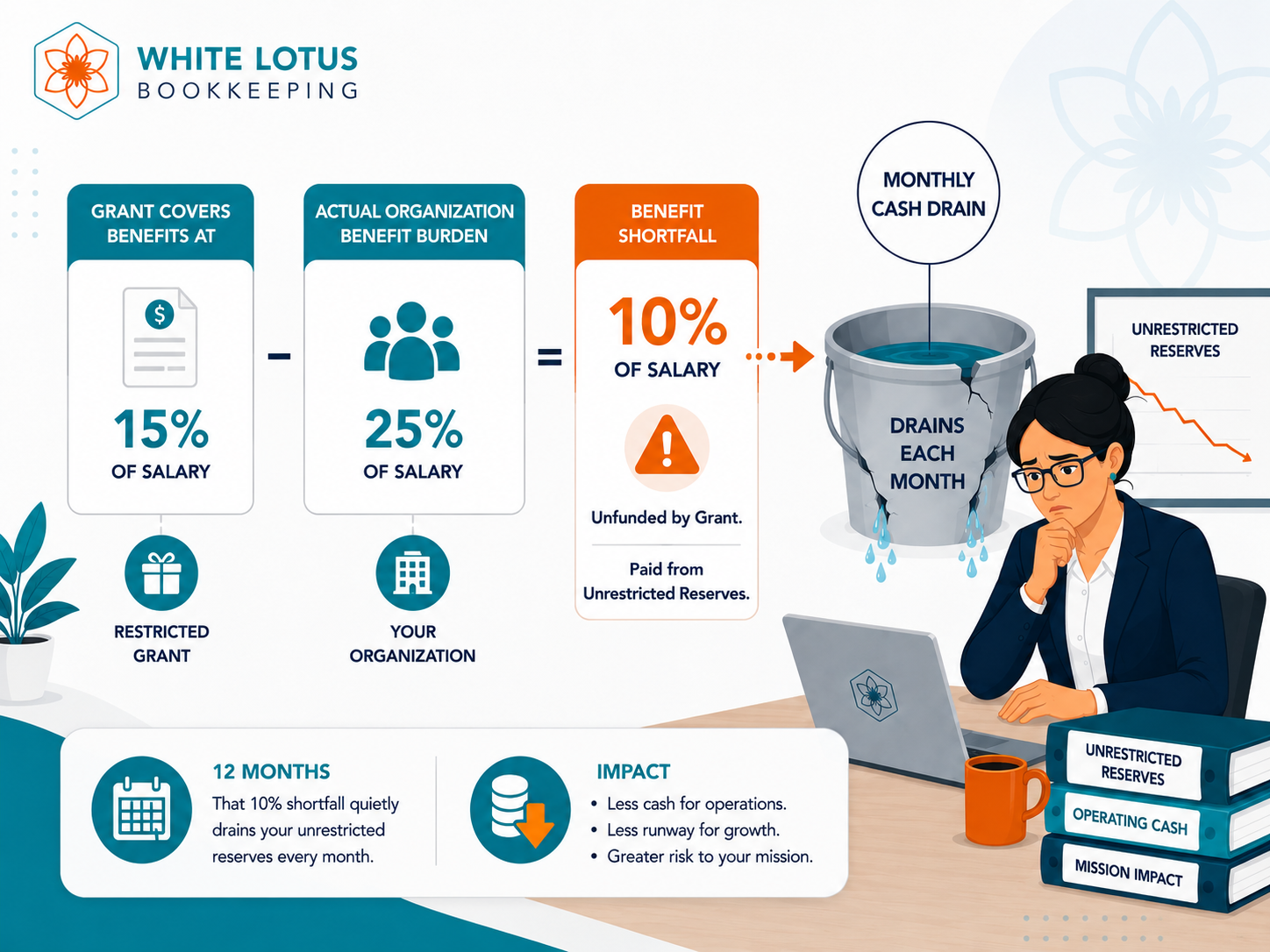
Do not guess when it comes to employee benefit costs. Have your accounting team calculate the exact percentage of benefits to salaries across the entire organization over the trailing 12 months. If you must accept a grant with a benefit shortfall, make that specific dollar gap a targeted goal for your next unrestricted fundraising campaign.
Run a Customer/Donor Summary Report for the trailing 12 months. Identify whether any single funding source accounts for more than 30% of your total operating budget. Map out the renewal and expiration dates for your top three funding sources—having two expire in the same quarter creates a severe cash flow cliff.
Evaluate your Chart of Accounts (COA) to ensure shared administrative costs—like rent, utilities, and leadership time—are accurately distributed across active grants to maximize allowable reimbursements. As a rule of thumb, an external auditor should be able to trace a specific grant expense back to its original source document within five minutes.
Scaling into the next fiscal year requires more than just bringing in additional grant funding. It demands an operational foundation that protects your unrestricted cash, diversifies revenue sources, and tracks shared costs with precision. By stress-testing your financial infrastructure today, you can confidently build a budget that supports sustainable growth tomorrow.
If your nonprofit is scaling rapidly but your bookkeeping and reporting systems feel stuck in the past, White Lotus Bookkeeping can help.
.png)


